
Reading Notes: Midtraining Bridges Pretraining and Posttraining distributions
Published:
Summary
A very well written paper studying the effects of timing and proportion/weight of midtraining data in foundation models.
The arxiv version is here
The first author of the paper, Emmy Liu is at Carnegie Mellon right now and maintains a site with other works too. Her site is here
Section 2
The paper has an excellent Section 2 that clearly defines key terms like pretraining, mid-training, finetuning, curriculum learning, and continued pretraining, as used in the paper. While other papers might use these terms it was great to have clear definitions so that the reader is on the same page as the authors.
Sections 3-6
Largely a collection of experiments, conducted way beyond Chinchilla optimal to ensure stability for introducing the midtraining data. All the experiments were done with a single GPU which is pretty impressive.
How much beyond Chinchilla Optimal?
How much beyond Chinchilla Optimal?
The paper didn’t seem to have a quantified writeup of how far past chinchilla optimal they are but the calculations are straightforward from the paper.
The models were 70-410 million and a 1 billion parameter model on the second draft. The authors used a 128 billion token dataset, on approximately 61,000 update steps. Using the \( C=6ND \) relationship where N is parameter count and D is the dataset size in tokens. Then using the heuristic of \(D=20N\) also from the chinchilla paper, after rearranging numbers, the 410 million parameter model is \( D=20 \times 4.1 \times 10^8 = 8.2 \) billion tokens at chinchilla optimal. This tells us that the 128 billion token dataset is over 15 times the chinchilla optimal size, eg. a lot past chinchilla optimal.
The key findings of this section is that datasets that are domain specific show the most benefit for midtraining. The paper focuses on code and math datasets, plus some more generic datasets on reasoning, finding that the math and code datasets when matched on downstream evaluations of math and code respectively, show the best performance improvements. Intuitive and nice to have such well controlled experiments to objectively confirm the intuitions many of us have on this step.
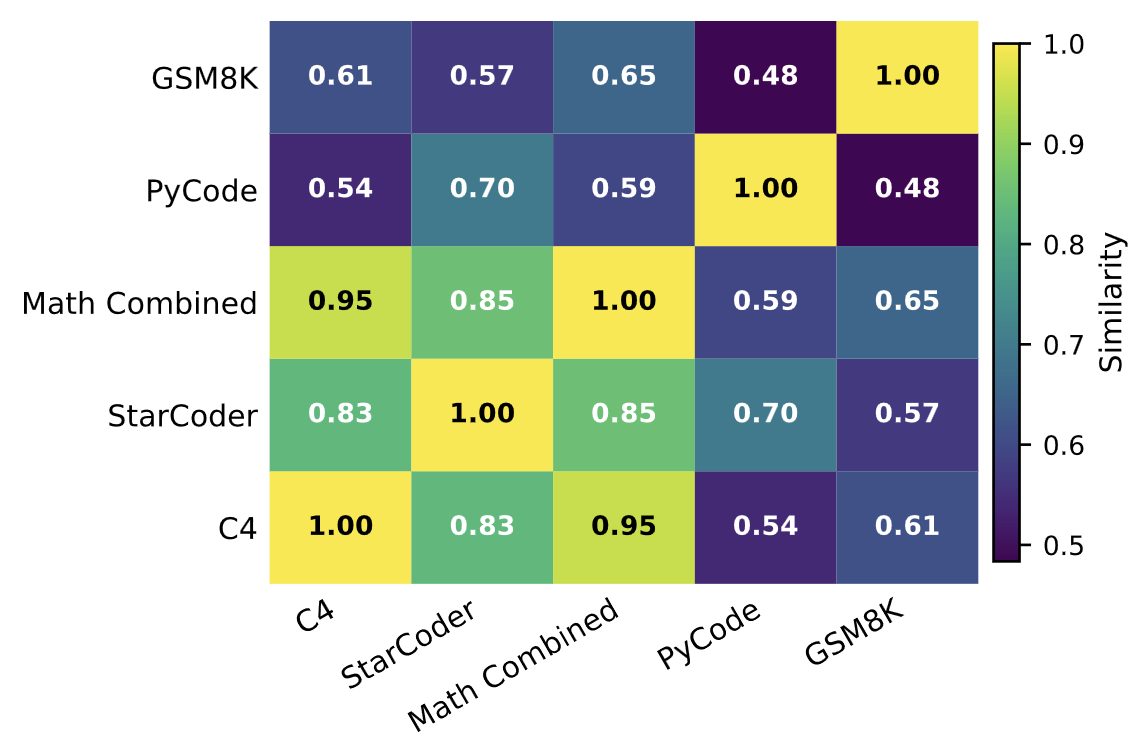
The paper measures proximity with a measure that is a convex combination of cosine similarity, Jaccard distance, and Jensen-Shannon similarity, giving only slightly more weight to cosine than the remaining two.
\[prox(d_1,d_2) = 0.4 \times cos(d_1, d2) + 0.3 \times Jaccard(d_1, d_2) + 0.3 \times JensenShannon(d_1, d_2),\]where \(d_i, i=1,2 \) are two distinct datasets.
The authors mention in the conclusion, Section 9, that extending to more domains would be a nice follow up.
Another thing the paper checks is the impact of midtraining on catastrophic forgetting by measuring cross entropy loss on a held out portion of the C4 data, which they ysed for pretraining.
There is also measures of structured fine tuning (SFT) on downstream tasks.
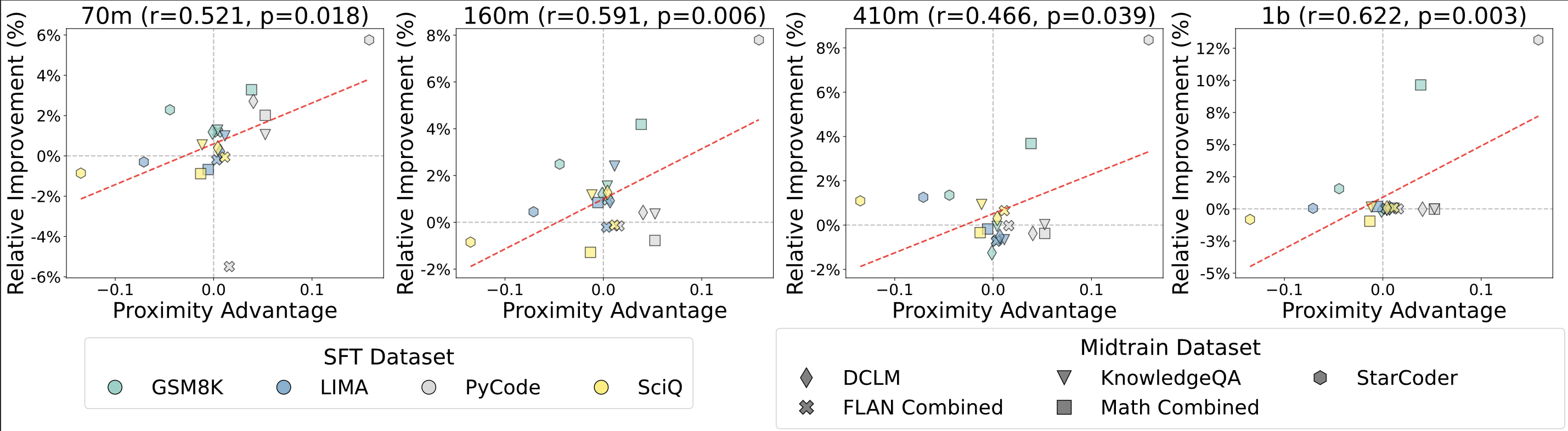
The key finding of proximity of the data to the downstream task is that it makes the performance on the downstream task better.
The studies looked at mixtures of midtraining data with the pretraining data, finding that the mixing is better than strictly cutting over to the midtraining data. It seems to make the loss landscape smoother and results in better performance on the downstream task than a strict cutover. This is something anyone who’s done what the paper defines as continued pretraining, a strict cutover to the domain specific dataset, has observed if they try the experiment, you usually don’t get as good performance with the strict cutover.
A nice follow up here would be to determine some sort of optimal weighting schedule for the datasets based on practical settings. The authors find that the timing, when they introduce the midtraining data has a larger impact than the weighting. To my mind, you can vary both if we take the weight as a function of the number of steps (timing) and the propotions and vary both. Because of the heavy cost of computing and the very restricted compute environment they have, only a single GPU it’s unsurprising they vary each part separately and not jointly.
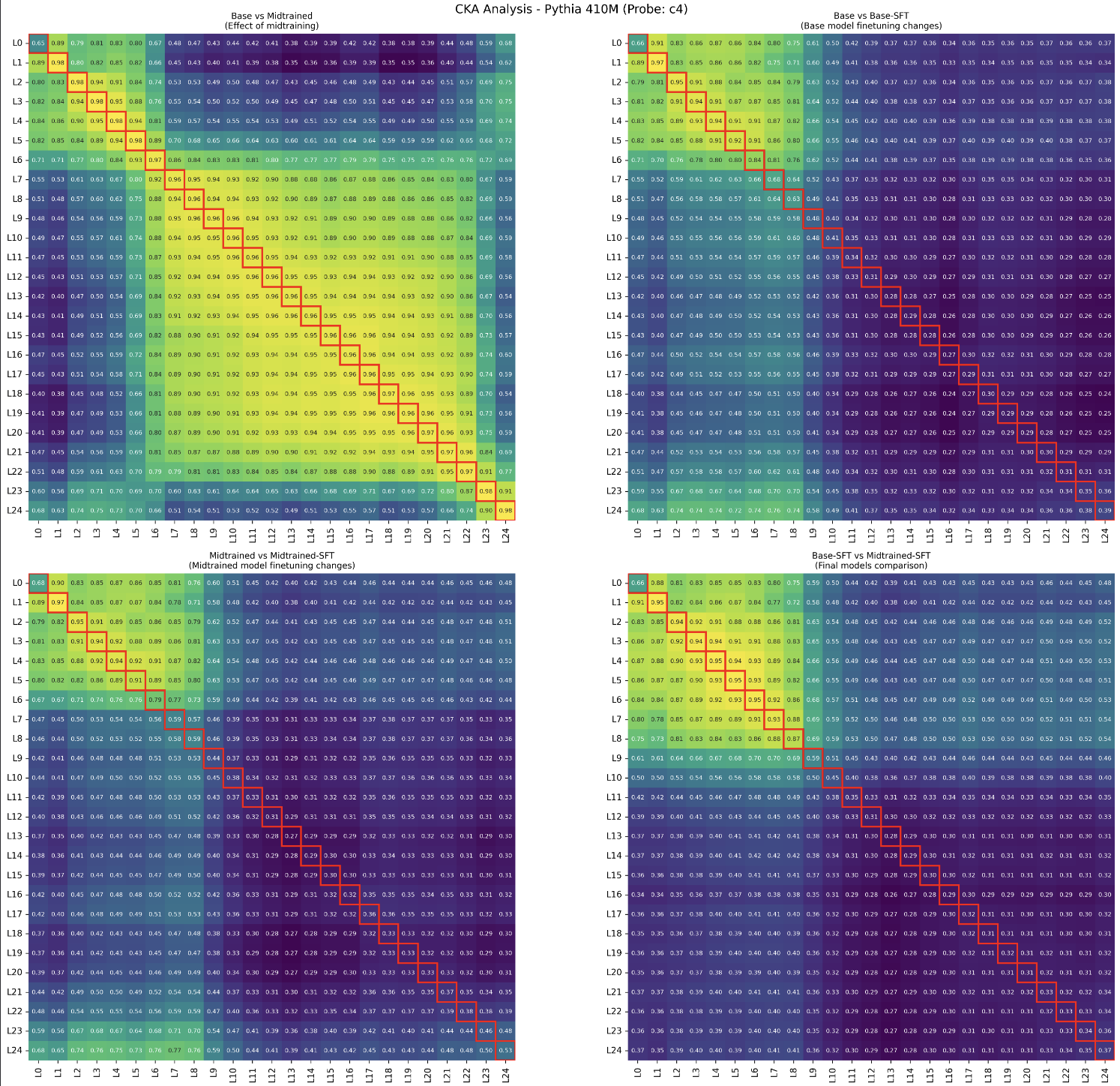
They also study the impact the weights have across the layers of the models. the general trend seems to be that the impact of the midtraining tends to center on the later weights in the model than the earlier layers but the dynamic changes if you look at SFT. With SFT the earlier layers seem to learn the changes to the domain.
Some answered and still unanswered questions
These questions are not a critique of the paper, the paper is a well written and clear paper as is, and in any work you must stop somewhere. Where the authors stopped is sensible and the findings leave open further questions to be answered, as any good research work does. Here are some things that seem like natural follow up studies-beyond those the authors indicated in the conclusion.
How much the optimizer matters?
The experiments all used adamW, using pretty reasonable hyperparameter settings for the experiments.
There is no answer to the question of if the optimizer matters. I’m curious if there are impacts of adamW vs Muon. If you’re reading this blog post and you’ve done those experiments and are willing to share, please drop me an email. I’d love to add them (with attribution) to this blog post.
How much does the model architecture matter?
The authors mostly study the Pythia family of models. It would be interesting to study some other families that, while similar, are often considered different.
My hypothesis is that while there may be differences, it’s likely the same trends are observed across model architectures.
How to expand to multiple domains simultaneously during midtraining?
No experiments on this topic, the authors were limited to only a few domains so if you’re into building more domain specific datasets for midtraining this is a space to contribute new learnings. If you know of several good midtraining datasets in domains beyond math and code, let me know and I’ll attribute the answers here in an update.
Models beyond 1 billion
The authors, as academics, were compute constrained so they did not study models larger than 1 billion parameters. Researchers who have the access to larger compute than a single GPU could contribute to checking these results on larger scales. There seems to be some emergent behavior at the 1 billion model as evidenced by the increased correlations but it’s not clear if this is noise or something indicative of an emergent phenomena.
Summary
The key takeways are:
Introduce midtraining data earlier in the training sequence of data than is typical to improve downstream performance on domain specific models. Align the domain with the downstream task.
Leverage midtraining as a means to reduce catastrophic forgetting, maintaining general reasoning and knowledge into the specializations.
Use a mixture of the pretraining data and the midtraining data rather than a strict cutover.
All the figures I’m using here in the blog post are from the original paper, I recommend you read it if you found this post interesting.